
Sustainability & world 2 min read
Solar and Your Carbon Footprint: How to Measure Your Plant's Impact
How many tonnes of CO₂ does your plant avoid, and how do you translate that into trees and litres of diesel? A practical guide to impact and sustainability reporting.
 GPS Engineering Team
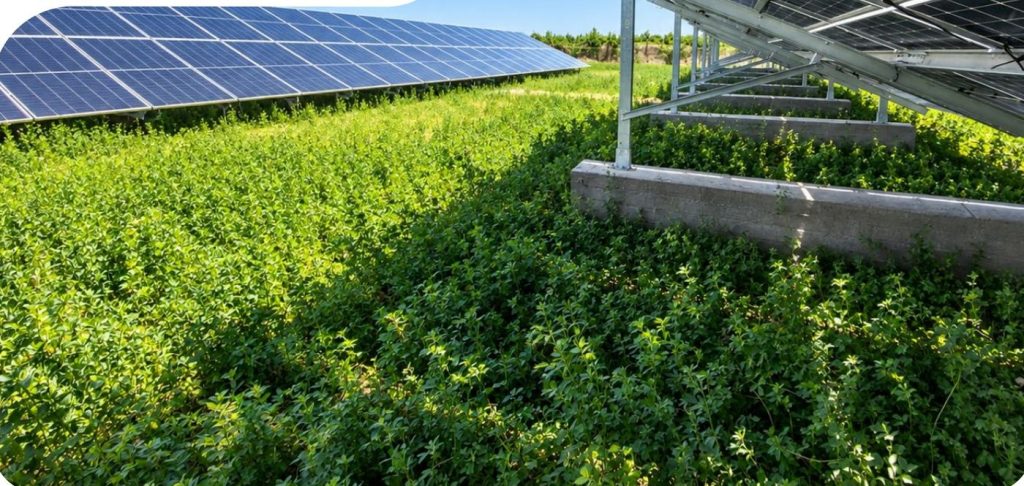
Solar’s environmental impact isn’t just a slogan: it can be measured precisely and reported in sustainability reports — increasingly a requirement for exporters, large companies and hotels. Here’s how to calculate the carbon footprint your plant avoids.
Key takeaways
- Each solar MWh in Egypt avoids roughly 0.5–0.6 tonnes of CO₂.
- A 1 MW plant produces about 1,800 MWh a year and avoids close to 1,000 t CO₂.
- The figures support ESG reports and European buyers’ requirements.
- Impact can be expressed in simple equivalents: trees, cars, litres of diesel.
The formula
Avoided emissions (t) = production (MWh) × grid emission factor
In Egypt we use an approximate factor of 0.5–0.6 t CO₂ per MWh, depending on the grid’s fuel mix.
Turning numbers into equivalents
| Equivalent | Approximate assumption |
|---|---|
| Trees | A mature tree absorbs roughly 20–25 kg CO₂ a year |
| Cars | A passenger car emits 2–4 t CO₂ a year depending on use |
| Diesel | Each litre burned emits about 2.7 kg CO₂ |
Why it matters commercially
- Exporters: European buyers ask for emissions data, and CBAM raises the stakes.
- Hotels: sustainability certifications influence tour operators.
- Large companies: net-zero targets reach into supply chains.
GPS in numbers
Plants delivered by GPS exceed 80 MWp, producing around 144 GWh a year and cutting tens of thousands of tonnes of emissions annually. See our impact.
Also read: global solar trends.
An engineer visits to measure the space, review consumption and give a final quote.

How much would your plant save?
Get system size, cost and expected savings in under a minute.
GPS engineers have designed and built solar plants across Egypt for 15+ years. Here they share what they learn in the field.
Frequently asked questions
Is the energy used to make panels counted?
In a life-cycle analysis, yes. Panels repay their manufacturing energy in roughly 1–3 years, leaving a strongly positive balance.
Can the plant earn carbon certificates?
Renewable energy certificates and carbon-credit schemes exist, each with registration and verification rules. We help provide the documented production data required.
Keep reading
 Sustainability & world
Global Solar Trends 2026: Prices, Technology and Storage
The world now installs hundreds of gigawatts of solar a year. We review the key trends in prices, technology and storage, and…
 Sustainability & world
Charging Electric Vehicles with Solar in Egypt: A Practical Guide
Can you charge your EV from rooftop panels? How many panels you need, home versus commercial charging, and how to integrate chargers…
Solar basics Solar Energy in Egypt 2026: The Complete Guide from Idea to Switch-On
Everything you need to know before going solar in Egypt: how it works, what it costs, how much it saves, which system…
 Costs & prices
Solar Prices in Egypt 2026: What Does a System Cost for a Home or Factory?
A detailed look at panel and system prices in Egypt in 2026, what pushes prices up or down, and worked examples for…
 Solar basics
How to Choose a Solar Company in Egypt: 10 Checks Before You Sign
Choosing the installer matters more than choosing the panel. Here are 10 practical checks that separate a professional solar company from the…
 Egypt: market & regulation
Net Metering in Egypt: Requirements, Steps and How the Credit Works
A plain-language guide to net metering in Egypt: who can apply, the paperwork, the role of the distribution company and accredited installer,…
Solar for business Solar for Factories in Egypt: Cutting the Power Bill by Up to 100%
A factory owner's guide to rooftop solar: right-sizing, structural checks, returns and examples from plants delivered by GPS.
 Solar for business
Solar for Hotels and Resorts on the Red Sea and in South Sinai
How hotels cut operating costs with solar without touching guest comfort: where to install, designing for coastal conditions and the expected return.