
Technology & equipment 2 min read
Cleaning Solar Panels in Desert Conditions: How Often and How?
Dust is one of the biggest causes of lost output in Egypt. Learn the right cleaning frequency, safe methods and common mistakes that damage panels.
 GPS Engineering Team
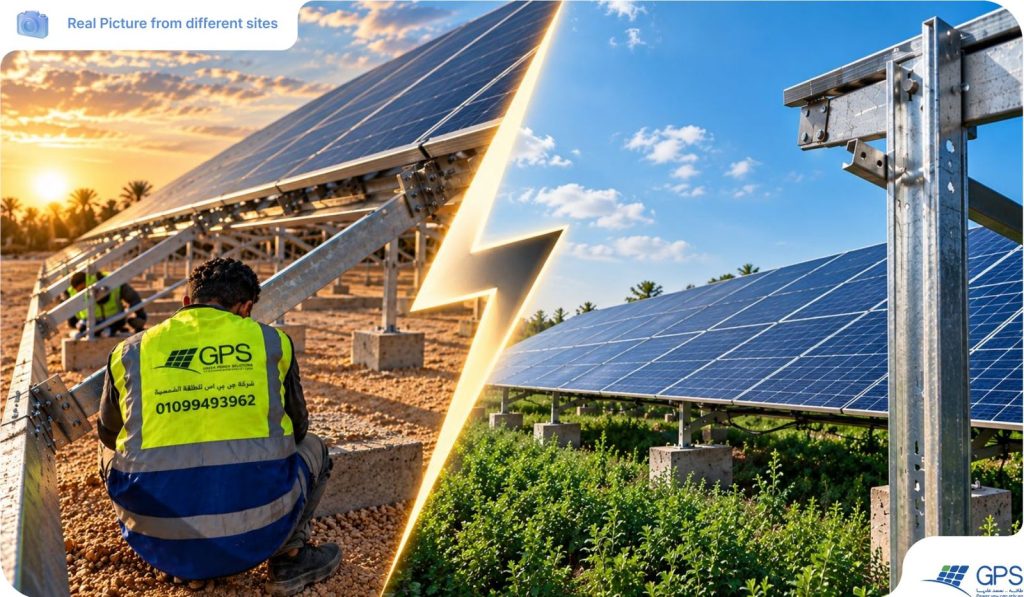
In a desert climate dust builds up quickly on panels, especially during khamasin season. A thin layer may look harmless, but it blocks part of the light and noticeably reduces output. That makes regular solar panel cleaning the cheapest way to raise your plant’s earnings.
Key takeaways
- Dust can cut output by 5% to over 25% if left for weeks.
- Cleaning every 2–4 weeks suits most sites in Egypt.
- Use low-mineral water and a soft brush, early morning or evening.
- Use monitoring data to time cleaning instead of a fixed calendar.
How much output does dust cost?
Cleaning methods
| Method | Best for | Notes |
|---|---|---|
| Manual water and brush | Homes and small plants | Simplest and cheapest |
| Long-handled brushes and treated water | Commercial roofs | Fast and safe with walkways |
| Waterless cleaning robots | Large ground plants | Save water, run at night |
| Truck-mounted rotating brushes | Utility-scale fields | For megawatt plants |
Cleaning correctly
- Clean early morning or after sunset to avoid thermal shock to hot glass.
- Remove dry dust first with a soft brush.
- Use low-mineral (ideally treated) water to avoid spotting.
- No harsh detergents, abrasives or high-pressure jets.
- Never walk on panels.
Data-driven cleaning
Instead of a fixed schedule, compare actual output with expected output on clear days. When losses pass a threshold (say 5%), cleaning pays for itself. That’s how GPS O&M contracts work, using smart monitoring.
Tips for farms and desert sites
- A slightly steeper tilt helps dust slide off.
- Raising panels off the ground reduces blown dust.
- Windbreaks or planting around the array cut dust.
An engineer visits to measure the space, review consumption and give a final quote.

How much would your plant save?
Get system size, cost and expected savings in under a minute.
GPS engineers have designed and built solar plants across Egypt for 15+ years. Here they share what they learn in the field.
Frequently asked questions
Is rain enough to clean panels?
Light rain can turn dust into mud and leave streaks, so in Egypt, where rain is scarce, it can't be relied on.
Do anti-soiling coatings help?
Some reduce dust adhesion but don't replace cleaning, and you should check compatibility with the panel warranty.
Keep reading
 Technology & equipment
On-Grid, Off-Grid or Hybrid? Which Solar System Is Right for You
A clear comparison of on-grid, off-grid and hybrid solar systems: how they work, cost, pros and cons, and when to choose each.
 Technology & equipment
Solar Panel Types: Mono, Poly, Bifacial, TOPCon and HJT — Which Is Best?
A simple guide to the panel technologies available in 2026, how they differ in efficiency, heat performance and lifespan, and when bifacial…
 Technology & equipment
The Solar Inverter: The Heart of Your Plant — Types and How to Choose
What the inverter does in a solar plant, the difference between string, central, micro and hybrid inverters, and how to choose size…
 Technology & equipment
Solar Batteries: Lithium or Lead-Acid? A Buyer's Guide
A practical comparison of lithium iron phosphate and lead-acid batteries by lifespan, depth of discharge and true cost, and when you need…
 Technology & equipment
Solar Panel Maintenance: A Practical Schedule for Maximum Output
A clear maintenance schedule for solar plants: what to check daily, monthly and yearly, how to catch faults early and keep your…
 Technology & equipment
Do Solar Panels Work in Extreme Heat? How Temperature Affects Efficiency
Heat lowers panel efficiency slightly, but strong sunshine more than compensates. Understand the temperature coefficient and how we design for Egyptian summers.
 Technology & equipment
Solar Warranties Explained: What a 25- or 30-Year Warranty Really Covers
The difference between product, performance and workmanship warranties, what voids them, and how to protect yourself before signing.
 Technology & equipment
Smart Solar Monitoring: Why Your Plant Shouldn't Run Without It
How solar monitoring works, which indicators to watch, and how it catches faults early and protects your investment.