
Solar basics 3 min read
Solar Energy in Egypt 2026: The Complete Guide from Idea to Switch-On
Everything you need to know before going solar in Egypt: how it works, what it costs, how much it saves, which system fits you and how to choose an installer.
 GPS Engineering Team
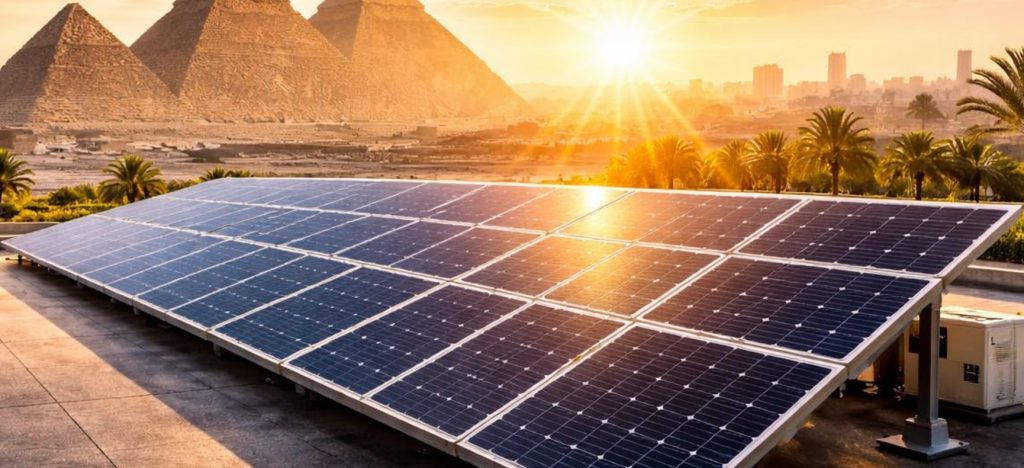
Egypt enjoys some of the strongest sunshine on the planet, and with electricity prices rising year after year, solar energy in Egypt has become a financial decision before it is an environmental one. This guide brings the whole picture into one place, in plain language and with realistic numbers from the hundreds of plants we have built.
Key takeaways
- Each installed kilowatt in Egypt produces roughly 1,600–1,900 kWh per year.
- In 2026 an on-grid system costs roughly EGP 12,000–18,000 per kWp depending on size.
- Payback is usually 3–6 years, while panels keep working for 25+ years.
- Net metering lets you offset the energy you export against your bill.
Why Egypt is one of the best places in the world for solar
Most governorates receive between 2,000 and 3,200 kWh of solar radiation per square metre each year, with 5–7 peak sun hours a day. The same panel installed in Aswan or on the Red Sea coast simply produces far more electricity than it would in Europe.
How a solar power plant works
A plant has four main building blocks:
- Solar panels convert sunlight into direct current (DC).
- The inverter converts DC into alternating current (AC) for your equipment and the grid.
- Structures, cables and protection devices hold the panels and carry the power safely.
- A bi-directional meter records what you import from and export to the grid.
Read more in our guide to on-grid, off-grid and hybrid systems.
How much does solar cost in Egypt?
Pricing is quoted per installed kilowatt and depends on the exchange rate, panel and inverter brands and project size. The larger the plant, the lower the cost per kilowatt.
| System size | Typical use | Approx. cost per kWp |
|---|---|---|
| 3–10 kW | Home or villa | EGP 15,000–18,000 |
| 20–200 kW | Shop, school, small hotel | EGP 13,000–15,000 |
| 500 kW + | Factory or large resort | EGP 11,000–13,000 |
How much will you actually save?
Every kilowatt-hour your panels generate is one you don’t buy from the grid. With higher household tiers raised by an average of 12% in August 2026 and commercial tariffs increased earlier in the year, payback periods are shorter than ever. Factories and hotels that consume during the day see the fastest returns, often 3–5 years.
Which system is right for you?
- On-grid: the most economical and most common; ideal for factories, hotels and grid-connected homes.
- Off-grid: for remote sites without a grid connection; requires batteries.
- Hybrid: combines the grid with batteries to keep power on during outages.
- Solar pumping: runs well and irrigation pumps directly instead of diesel.
Steps to deliver your project with a solar company
- Site survey and review of your electricity bills.
- Engineering design and yield simulation.
- A clear quotation covering every component and warranty.
- Supply, installation and testing.
- Net-metering paperwork and meter installation.
- Commissioning, monitoring and scheduled maintenance.
See each step in detail in how a solar plant is installed.
The bottom line
Solar in Egypt is no longer a luxury. It is a long-term investment with a clear return and a hedge against future tariff increases. Start by estimating the size and cost of your plant, then book a free site visit for an accurate design.
An engineer visits to measure the space, review consumption and give a final quote.

How much would your plant save?
Get system size, cost and expected savings in under a minute.
GPS engineers have designed and built solar plants across Egypt for 15+ years. Here they share what they learn in the field.
Frequently asked questions
Does solar work in winter in Egypt?
Yes. Output dips slightly because days are shorter, but mostly clear winter skies keep production healthy, and this is built into the annual design.
Do I need batteries with an on-grid system?
No. An on-grid system works without batteries and uses the grid as storage through net metering. Batteries are only needed if you want power during outages.
How long does a mid-size project take?
A home system is installed in 2–4 days; a 500 kW factory plant usually takes 4–8 weeks including supply and testing.
Keep reading
 Solar basics
How to Choose a Solar Company in Egypt: 10 Checks Before You Sign
Choosing the installer matters more than choosing the panel. Here are 10 practical checks that separate a professional solar company from the…
 Solar basics
How Many Solar Panels Do You Need? A Step-by-Step Calculation
Work out the number of panels and system size yourself from your electricity bill, with examples for a home, factory and farm,…
Solar basics How Much Space Does Solar Need on Roofs and Land?
How many square metres per kilowatt? A space guide for concrete roofs, metal roofs and ground mounts, and how shading and walkways…
 Solar basics
12 Solar Energy Myths — and the Reality We See on Site
Do panels stop in winter? Do you always need batteries? Do they die after five years? We bust the most common solar…
 Solar basics
How a Solar Plant Is Installed: From Site Survey to Switch-On
What exactly happens from first call to commissioning? We walk through each project stage, how long it takes and your role in…
 Solar basics
15 Questions to Ask Before Installing Solar (Checklist)
A practical checklist that protects you from bad decisions: questions for yourself, for the installer, and about warranty and maintenance before signing.